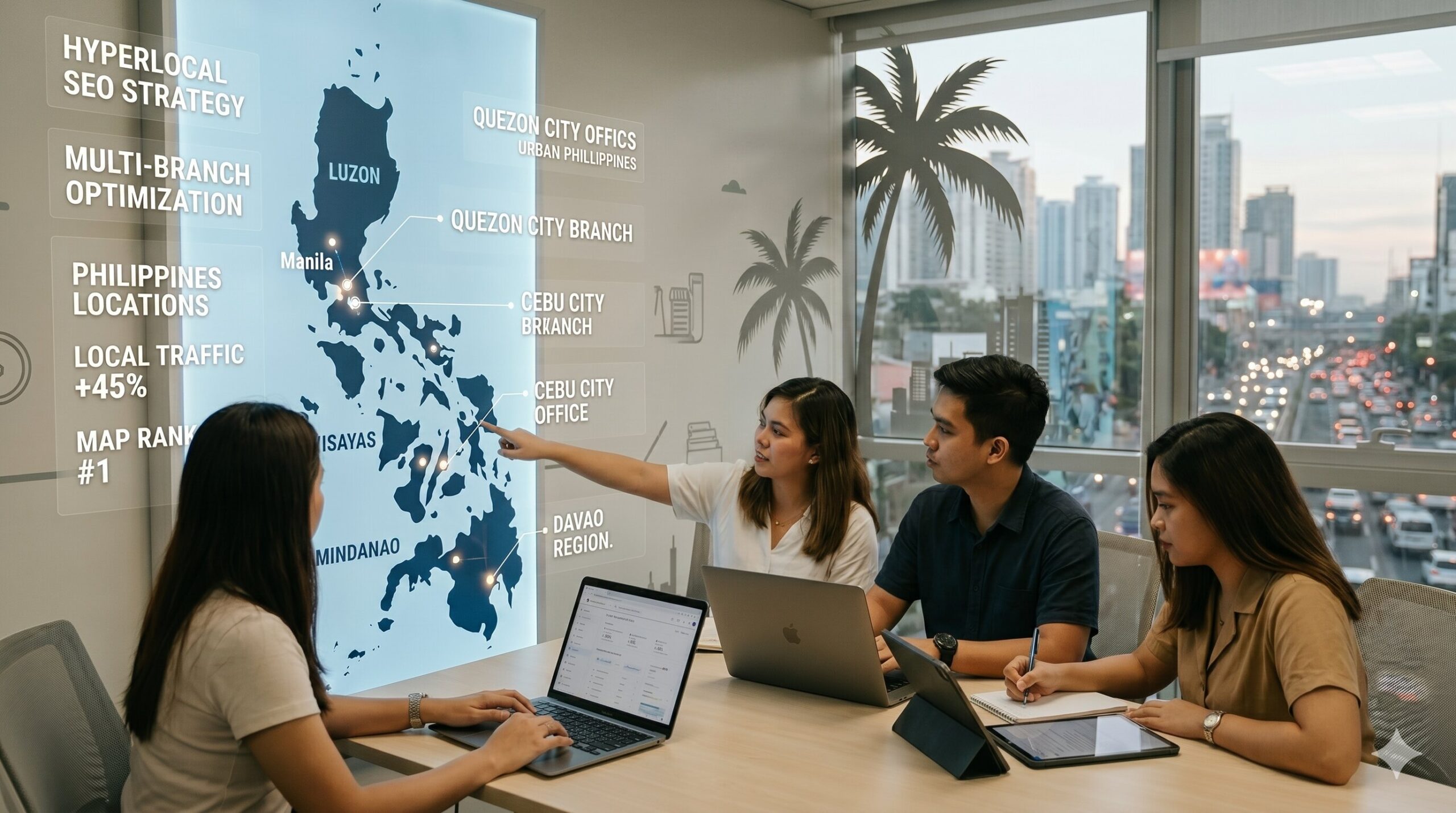
Multi-branch businesses in the Philippines have a structural advantage over big brands in local search – and most of them never use it. A national chain with 200 branches manages SEO from a central marketing team that treats all locations the same. A regional business with 8 branches in Cebu, 5 in Davao, and 12 in Metro Manila can treat each location with the specificity that actually wins local rankings.
Hyperlocal SEO is the practice of optimising each branch for its specific barangay, district, or city – not just the general region. After working with multi-branch clients across healthcare, retail, and professional services in the Philippines, the pattern is consistent: businesses that go hyperlocal out-rank SM, Ayala, and Mercury Drug in the searches that actually drive foot traffic and enquiries. Here is how they do it.
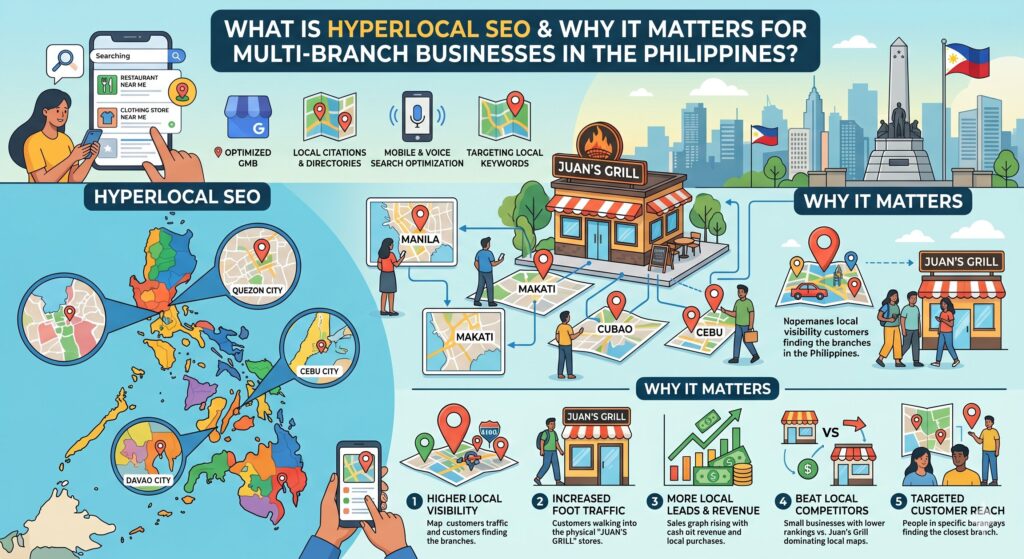
What Is Hyperlocal SEO and Why Does It Matter for Multi-Branch Businesses in the Philippines?
Hyperlocal SEO is search engine optimisation targeted at a specific neighbourhood, barangay, or district rather than a broad city or region. For multi-branch businesses in the Philippines, it means each branch ranks for searches that include its immediate surroundings – not just “dental clinic Quezon City” but “dental clinic Cubao” or “dental clinic near Araneta Center.”
Why it matters: Google’s local ranking algorithm prioritises proximity, relevance, and prominence. Proximity is geographic distance between the searcher and the business. A big brand with one Quezon City branch cannot beat a clinic that has a branch in Cubao AND optimises that listing specifically for Cubao searches. Proximity always beats brand size in local search.
The Philippines context adds another layer. With 81 provinces, 145 cities, and over 42,000 barangays, the geographic specificity of Filipino search behaviour is unusually high. Patients and customers frequently search by landmark, mall, or barangay name:
| Generic Search (Big Brand Wins) | Hyperlocal Search (Multi-Branch Wins) |
|---|---|
| “hearing clinic Philippines” | “hearing clinic Robinsons Galleria” |
| “physiotherapy Manila” | “physiotherapy Kapitolyo Pasig” |
| “dental clinic Makati” | “dental clinic Salcedo Village” |
| “GP clinic Cebu” | “GP clinic Lahug Cebu City” |
| “accountant Davao” | “accountant Ecoland Davao” |
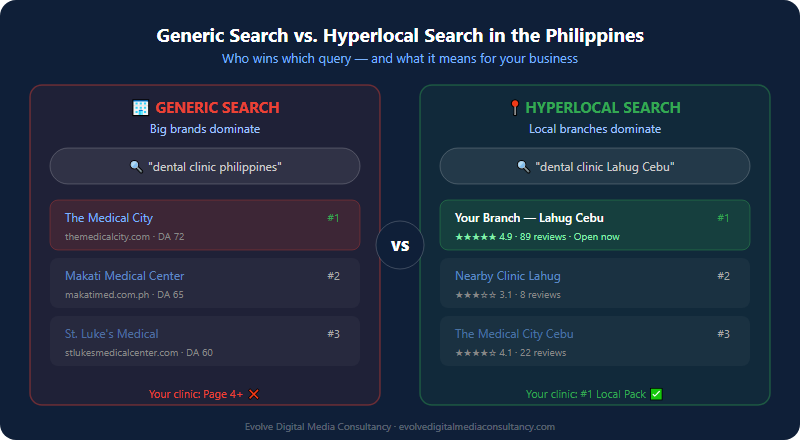
Rank for the hyperlocal query and you win the walk-in. Rank only for the broad query and you compete with national brands that have ten times your domain authority.
How Do Big Brands Dominate Local Search – and How Multi-Branch SMEs Can Beat Them?
Big brands dominate broad local search through three factors: domain authority built from years of backlinks, brand recognition that inflates click-through rates, and marketing budgets that fund constant content production. A business like The Generics Pharmacy or Jollibee ranks for “pharmacy near me” or “fast food Philippines” because Google trusts their root domain deeply.
Multi-branch SMEs cannot beat that on broad terms. What they can beat is specificity. Here is why:
Big brands centralise content – A national chain writes one page for “all our Manila branches.” An independent multi-branch business can write a unique page for each branch location with content that no central marketing team will ever produce at that granularity.
Big brands cannot hyperlocal-ise at scale – Robinsons Supermarket cannot write a blog post about “the best grocery delivery routes in Barangay Holy Spirit, Quezon City.” A local grocery chain with 4 branches in QC can, and that content will rank for searches that the national brand simply does not target.
Big brands have inconsistent Google Business Profiles – Large chains frequently have unclaimed, incomplete, or mismanaged GBP listings for individual branches. Every unclaimed listing is an opportunity for a local competitor who manages theirs properly.
The winning strategy is not to compete head-to-head on brand terms. It is to dominate the 50-200 hyperlocal searches that represent 80% of the walk-in and call-in business for each branch.
How Should Multi-Branch Philippine Businesses Structure Their Google Business Profiles?
Each branch of a multi-branch Philippine business needs its own, fully optimised Google Business Profile – not a shared profile, not a merged listing. This is the single highest-ROI local SEO action available to multi-branch businesses.
Structure each GBP with:
Consistent NAP per branch – Name, Address, Phone must match exactly what is on the website, Facebook page, and any directory listings. Even minor variations (“St.” vs “Street”, “+63” vs “0”) create inconsistency signals that reduce local ranking.
Branch-specific categories – The primary category must reflect what that specific branch does. If your branch in Davao is primarily a hearing clinic but also offers physiotherapy, set “Hearing Aid Store” or “Audiologist” as primary, not “Medical Clinic” (which is too generic).
Localised business description – Write each branch description mentioning the specific area it serves, nearby landmarks, and services. “Serving patients in Davao’s Ecoland, Matina, and Catalunan areas since 2018” outperforms “We are a medical clinic.”
Regular Google Posts – Post updates, promotions, and events at least twice a month per branch. GBP listings with active posts rank higher in the Local Pack than inactive ones.
Photo uploads per branch – At minimum: exterior photo (helps patients find the branch), interior photo, staff photo, and service/product photo. Listings with 10+ photos receive 35% more click-throughs than those with 1-3 photos.
| GBP Element | Minimum Standard | Best Practice |
|---|---|---|
| Photos | 4 (exterior, interior, staff, service) | 15-20 photos |
| Reviews | 10+ with responses | 50+ with all responses |
| Posts | Monthly | Bi-weekly |
| Q&A | Populated with 5 FAQs | 10+ answered |
| Services listed | Primary services | Full service list with descriptions |
| Business hours | Current and accurate | Holiday hours updated proactively |
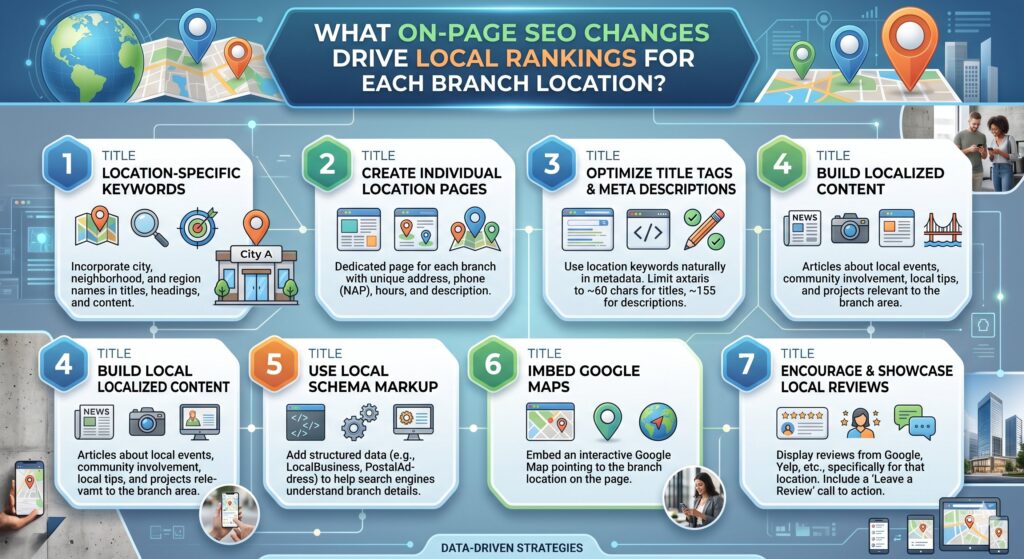
What On-Page SEO Changes Drive Local Rankings for Each Branch Location?
Each branch location needs a dedicated page on the website – not a shared locations page. A page titled “Our Branches” with a list of addresses provides almost no local SEO value. Individual pages titled “Hearing Clinic – Lahug, Cebu City” and “Hearing Clinic – Mandaue City” rank for distinct local queries.
On-page requirements for each branch page:
H1 with branch-specific keyword – Include the service type and specific location: “Dental Clinic in Kapitolyo, Pasig City.” This is the primary ranking signal for the page.
Embedded Google Map – Embed the specific branch’s GBP map directly on the page. This creates a confirmed geographic signal that connects the web page to the GBP listing.
Local content block – Add 150-300 words of content specific to that location. Mention nearby landmarks, which communities the branch serves, parking or transport access, and any branch-specific services or hours. This content cannot be templated identically across branches – Google detects and discounts duplicate local content.
Schema markup for each branch – Use LocalBusiness schema with the exact NAP, coordinates, opening hours, and service area for each branch. This is what populates rich results in Google Search.
Internal linking between branch pages – Link each branch page to related service pages and to nearby branch pages. This distributes page authority across the branch network and helps Google understand the geographic spread of the business.
Pro Tip: Add a “Serving these barangays” section to each branch page. List 8-15 specific barangays within a 3-5 km radius of the branch. This directly targets the hyperlocal search queries that patients and customers use – searches like “dentist near San Antonio Makati” – and almost no competitor in the Philippines does this systematically.
How Does Hyperlocal Content Give Philippine Businesses an Edge Over National Chains?
Hyperlocal content – blog posts, guides, and service pages written specifically for a geographic area – gives multi-branch Philippine businesses ranking opportunities that national chains structurally cannot compete for.
National chains produce content for broad audiences. “How to choose a hearing aid in the Philippines” is content that any brand can write. “Where to get a hearing test in Iloilo City” is content that is only valuable if you have a branch in Iloilo – and if you do, you should own that ranking.
Content types that work for Philippine multi-branch hyperlocal SEO:
Branch area guides – “Dental Services in Eastwood City Libis: What Patients Near Quezon City Need to Know.” Ranks for multiple geographic and service keyword combinations.
Local condition content – Philippine geography creates genuinely local health and lifestyle needs. “Managing Hearing Loss in Cebu’s Noisy Carbon Market Area” is specific, useful, and un-copyable by a brand that does not know that area.
Community event tie-ins – Filipino businesses have a natural advantage in producing content connected to local fiestas, barangay health days, and school events. “Free Dental Check for Lahug Fiesta 2026” earns local links and GBP engagement simultaneously.
Competitor gap content – Use Google Search to find what patients near each branch are asking. Questions like “Is The Generics Pharmacy in [area] open on Sundays?” signal that patients want location-specific information that the big brand is not providing. Answer those questions on your branch page.
What Are the Biggest Hyperlocal SEO Mistakes Multi-Branch Businesses in the Philippines Make?
The biggest hyperlocal SEO mistake multi-branch Philippine businesses make is creating duplicate branch pages – copying the same content across every location and changing only the city name. Google identifies this pattern and suppresses all the duplicate pages from local rankings.
Five hyperlocal SEO mistakes to fix immediately:
Templated branch pages – Identical content across branches with only the location name swapped. Every branch page must have at least 60% unique content. The local content block, landmark references, staff mentions, and community content must be genuinely different.
One GBP for all branches – Using a single shared Google Business Profile for multiple locations. Each physical branch must have its own GBP listing with its own address, phone number, and photos.
Inconsistent NAP across platforms – Branch address listed differently on the website, GBP, Facebook, and Grab Food/Foodpanda. A clinic listed as “2F Robinsons Place” on one platform and “Unit 201, Robinsons Mall” on another creates conflicting location signals.
No branch-specific review strategy – All reviews going to a single company GBP instead of the individual branch listing. Reviews on the branch-specific listing directly improve that branch’s Local Pack ranking.
Missing schema on branch pages – No LocalBusiness schema on individual branch pages means Google relies entirely on visible page content for location signals. Schema provides explicit, machine-readable confirmation of NAP, coordinates, and service area.
How Do You Measure Hyperlocal SEO Success Across Multiple Branches?
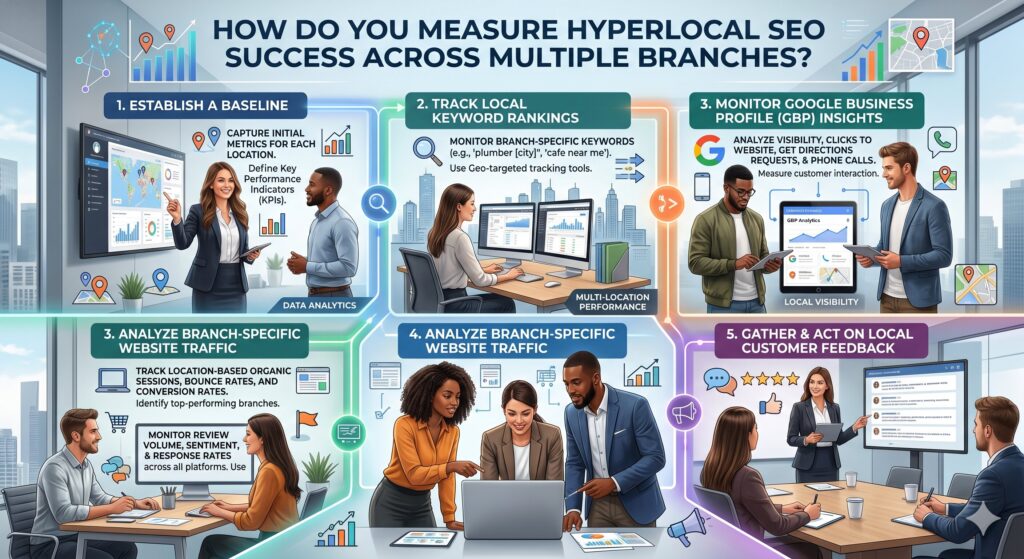
Measure hyperlocal SEO success at the branch level using three primary metrics: GBP insights per branch, local keyword rankings, and lead source attribution by location.
GBP Insights – Google Business Profile provides monthly data on searches, views, direction requests, calls, and website clicks per listing. Track these per branch, not in aggregate. A branch that shows declining direction requests is losing visibility in Maps searches – investigate immediately.
Local keyword rank tracking – Use a rank tracking tool set to track keywords from specific city locations. “Dental clinic Pasig” should be tracked as a Pasig search, not a Manila search. Rankings differ by 3-7 positions depending on the searcher’s location.
Lead source attribution – Tag all inbound calls and form submissions by branch. For phone leads, use unique tracking numbers per branch. For web leads, ensure the contact form captures which branch page the lead came from.
Monthly reporting table per branch:
| Metric | Baseline | Month 1 | Month 3 | Month 6 |
|---|---|---|---|---|
| GBP profile views | – | – | – | – |
| Direction requests | – | – | – | – |
| Phone calls from GBP | – | – | – | – |
| Local Pack appearances (tracked keywords) | – | – | – | – |
| Branch page organic sessions | – | – | – | – |
| Enquiries attributed to branch | – | – | – | – |
Populate this table at setup and review monthly. Branches that are underperforming after 90 days need either GBP optimisation, review acquisition, or additional localised content – the data will tell you which.
Evolve Digital Media Consultancy specialises in hyperlocal SEO for multi-branch businesses across the Philippines and Singapore. We manage location-by-location optimisation for healthcare groups, retail chains, and professional service firms with 2 to 50+ branches. Contact us for a free local SEO audit of your branch network.
Frequently Asked Questions
How many Google Business Profiles does a multi-branch business need?
Each physical branch with a unique address needs its own Google Business Profile. This is not optional for local SEO – Google’s local ranking algorithm ranks individual GBP listings, not company brands. A 10-branch business should have 10 separate, fully optimised GBP listings. Using a single profile for all branches means only one location can rank in the Local Pack at any time.
How long does hyperlocal SEO take to show results in the Philippines?
GBP optimisation produces visible results in 30-60 days – faster than traditional organic SEO. Adding photos, completing all profile sections, and generating new reviews can shift a branch’s Local Pack ranking within 4-6 weeks. Branch website page optimisation takes 60-90 days. New hyperlocal content ranks in 90-180 days depending on competition and domain authority.
Do multi-branch businesses in the Philippines need a separate website for each branch?
No – branches should be subdirectories or subpages of the main website, not separate domains. A structure like clinicname.com/cebu-branch/ or clinicname.com/davao-lahug/ is correct. Separate domains dilute domain authority and create duplicate content problems. The only exception is if branches operate under genuinely different brand names.
What is the most important local SEO ranking factor for Philippine businesses?
Google Business Profile optimisation is the single most impactful ranking factor for local search in the Philippines. A fully completed, actively managed GBP listing with recent reviews, regular posts, and accurate NAP consistently outranks websites with higher domain authority that neglect their GBP. Start here before any on-page work.
How do you handle hyperlocal SEO for branches in the same city?
For branches in the same city, differentiate by neighbourhood, district, or landmark. Two dental clinics in Quezon City should be optimised for “dental clinic Cubao” and “dental clinic Fairview” respectively – not both for “dental clinic Quezon City.” The keyword overlap will cause the pages to compete with each other (keyword cannibalism). Each branch page needs a distinct primary keyword tied to its specific sub-area.
Is Facebook or Google more important for local discovery in the Philippines?
Both serve different discovery functions. Filipino consumers frequently use Facebook to discover and research local businesses, particularly through recommendations and community groups. Google captures active purchase intent – patients and customers searching for a specific service right now. Multi-branch businesses in the Philippines need both: a strong GBP network for Google search traffic and active Facebook pages per branch for community engagement and referral discovery.